Public ad research source package
Turn Meta Ad Library into market intelligence.
Meta gives you a public browsing surface. Pullmesh gives you the source for a private research console: pull thousands of public ads into one verified run, search across runs, inspect deeper creative formats, keep long jobs checkpointed, and export evidence your team can use.
- Verified checkpoint
- 5,000 5,000 unique ads · 0 duplicates · stored run reverified 2026-08-26
- Export schema
- 65 analyst fields per ad record
- Current test record
- 180 + 6 Python + frontend tests passed · 2026-08-26
- Export formats
- 4 ZIP, CSV, JSONL, JSON with manifests
- ad_archive_id
- 72044...931
- page_name
- Northwind Co.
- verified_run
- 5,000 ads
- search_all
- indexed
- duplicates
- 0
Why buyers use it
Most Meta Ad Library research dies in tabs, screenshots, and half-finished spreadsheets. This gives a media buyer or agency a private ad-intelligence loop: collect at serious scale, interrogate the market, and hand off clean evidence.
-
Pull the market, not a tiny sample
Set public-ad targets around a niche, country, advertiser group, offer, or date range. The console is built for high-volume collection: verified on a 5,000-ad checkpointed run, architected to scale further as your environment and rate limits allow.
-
Find angles faster than manual browsing
Search across collected jobs, sort by recency or creative reuse, and filter by text, status, format, platform, advertiser signals, destination domains, spend/impression floors, and regional transparency fields.
-
Provenance-tracked transparency exports
Per-ad EU/UK/BR reach broken down by country, age, and gender, plus payer/beneficiary and included/excluded targeted locations, each export carrying a manifest of the filters and counts that produced it.
-
Keep long runs alive
Long ad-library pulls fail in the real world. Jobs checkpoint progress, preserve resume state, track shard progress, and verify duplicate IDs so operators do not lose the day because one session breaks.
-
Ship research people can use
Export ZIP, CSV, JSONL, or JSON packs with manifests, advertiser rollups, asset rows, CTA/domain summaries, DPA/DCO and carousel fields, creative variant counts, and optional raw records for analysts or client reports.
See it run
A recorded walkthrough of a real collection job on public Meta Ad Library data, plus captures from the same run. Nothing on this page is a mock-up of the interface.
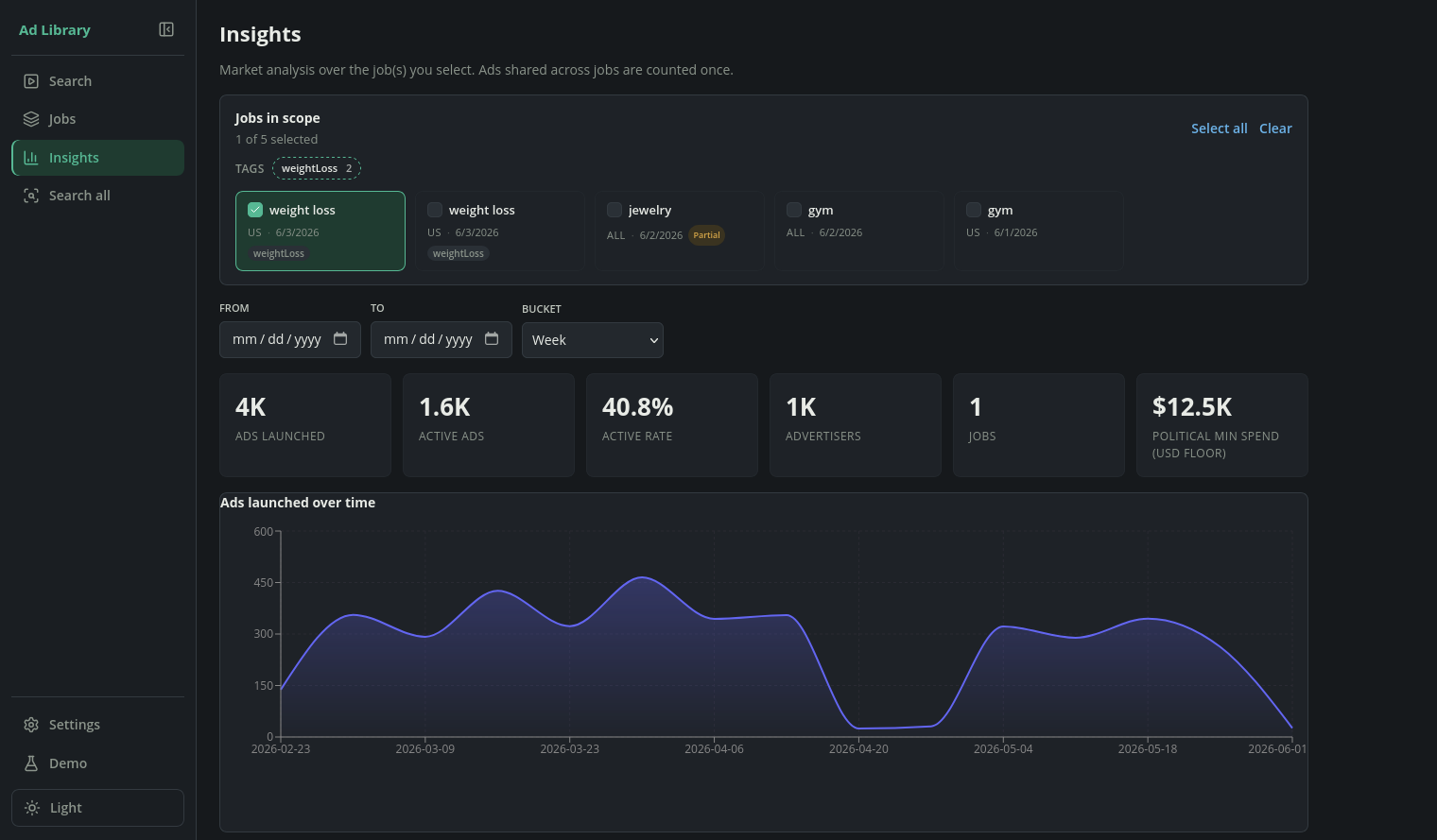
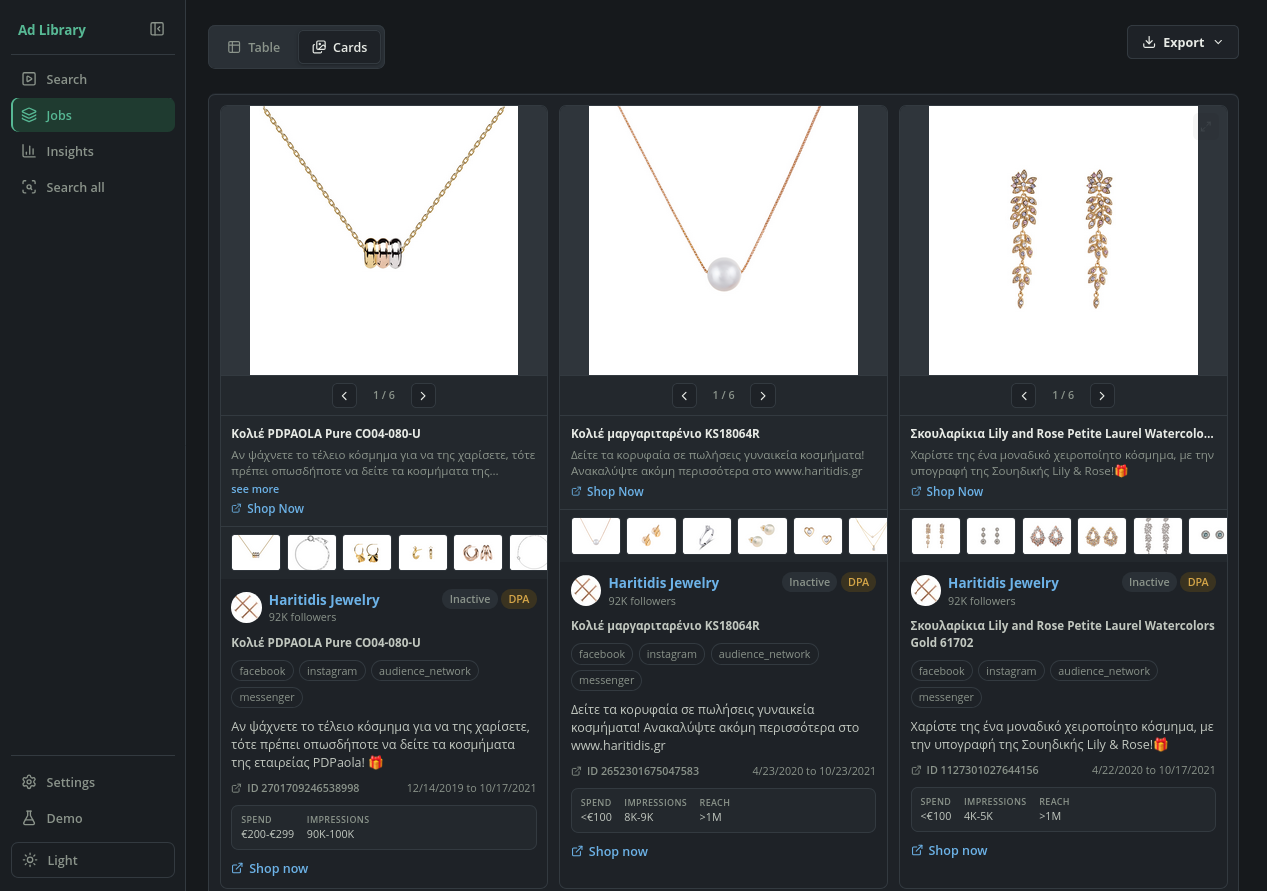
Real captures from the recorded run. Advertiser pages shown are public Meta Ad Library transparency entries.
What ships in the handoff
The handoff contains the working source, documentation, tests, safe sample material where available, and known-limitations notes. Before payment, you receive a draft licence and written order defining the buyer, permitted use, restrictions, delivery, and any support. Source ownership does not transfer.
included
- adlib/ collection engine and replay helpers
- FastAPI local backend with export endpoints
- React/Vite operator console source
- Sanitized demo dataset and export builder
- Tests, docs, sale-package scripts, and limitations notes
- Written order with scope, exclusions, delivery, and any agreed support
components
- High-volume collection core
- Source for the collection layer behind large public-ad runs, including parallel date-window search, shared targets, dedupe, checkpoints, resume state, and verification.
- Searchable intelligence workspace
- A local console for launching jobs, reviewing table/card results, searching across runs, tagging findings, checking diagnostics, and drilling into transparency and disclosure fields.
- Client-ready export pipeline
- Filtered or full backend exports that go beyond the visible UI page: ads, advertisers, assets, transparency rows, summaries, manifests, and optional raw records.
How intent becomes output
The operator path, start to finish. Each step is a real command surface, not a promise.
- 01
Aim
Pick the market: query, country, advertiser scope, status, format, language, platforms, date range, and collection target.
- 02
Collect
Run fast parallel searches or exact slower pulls while checkpoints, shard progress, retries, partial states, and deduped totals stay visible.
- 03
Interrogate
Use Search All, filters, table/card review, transparency panels, tags, diagnostics, and insights to identify hooks, offers, CTAs, formats, and domains.
- 04
Deliver
Export clean research packs with provenance, filters, counts, summaries, assets, advertiser rollups, and manifest data.
What's proven, what's excluded
The same diligence a technical buyer would run: what the code demonstrates locally, and what is deliberately left out of a clean handoff.
✓ proven
-
Working source, not a mockup
On 2026-08-26, the current repository passed 180 Python tests and 6 frontend tests. Buyers can request the check output and should rerun it on the exact bundle they evaluate.
-
Buyer-safe demo mode
Sanitized sample data drives the same export builder as real jobs, so a buyer can inspect behavior without private production datasets.
-
Built for buyer operation
The package is source code and documentation for the buyer to run, modify, and validate in their own authorized environment.
! excluded
-
No accounts included
No Meta accounts, cookies, tokens, browser profiles, proxy accounts, or raw production datasets are part of the default handoff.
-
Platform behavior can change
Meta surfaces, browser behavior, rate limits, access controls, and export fields can change without notice.
-
Buyer review required
Buyers should rerun verification in their environment and perform legal, platform, privacy, and operational review before use.
-
Licence terms before payment
The draft licence and written order identify the buyer, permitted internal use and modification rights, restrictions, delivery, and any support. Source ownership does not transfer. Review both documents before paying; the signed order and delivered licence govern.
Build it yourself, or start from the source
Request handoff
Review the ad-research source before you buy.
Two collection engines, checkpoint/resume/verify, a 65-field export pipeline, and a reproducible sale-readiness gate. The source licence is available for a one-time $1,500 price. Request the handoff to inspect the dated evidence and current bundle.
Request handoffOpens the package-specific request form. You can also write to [email protected] and mention the meta ad library collection console.